
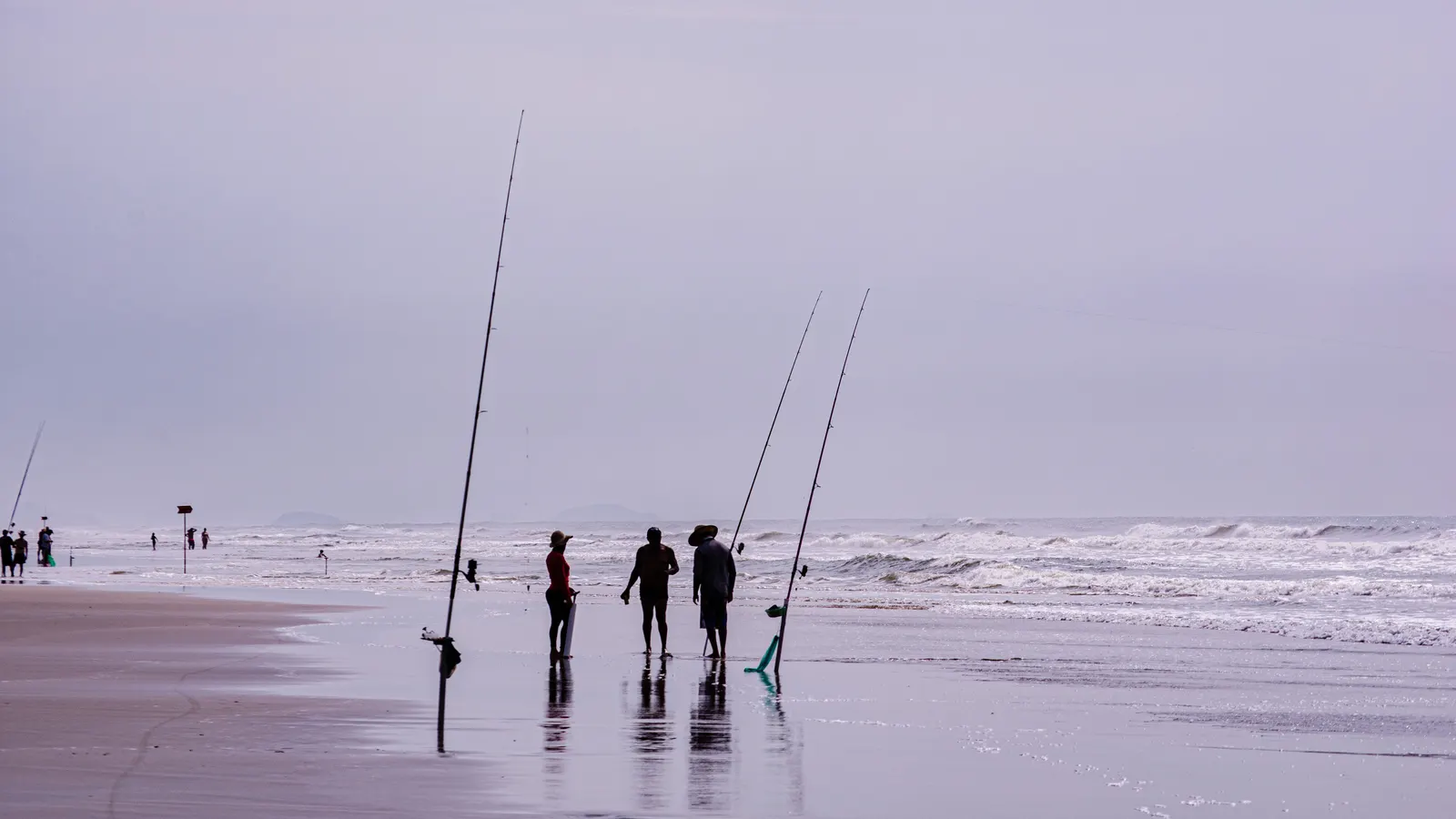
Surf fishing in Maine is a striped bass game. From roughly mid-May through mid-October, migratory stripers work the beaches and river mouths from Ogunquit to the Kennebec, and you can catch them standing on sand with a 10 foot rod. No boat. No conventional license, just a $1 registration with the state. The best water is where rivers meet the ocean: Popham, the Saco mouth, Scarborough Marsh, Ogunquit. This guide covers when the fish arrive, where shore anglers actually go, how to pick a tide, and the 2026 rules that are earning careless anglers summonses this summer.
What surf fishing in Maine actually is
Most surf fishing articles are written for New Jersey and stretched to fit. Maine’s shore fishery is shorter, colder, and built around one fish.
Striped bass are migrants. Most of the fish you’ll catch here were spawned in Chesapeake Bay, with Hudson River fish mixed into the coastal run, plus a small local population that spawns in the Kennebec (Maine DMR has tracked it with a juvenile striper survey since 1987). They ride the warming water north in spring, spend the summer in our rivers, estuaries, and beach troughs, then push south again in fall. Everything about the season follows that clock.
Atlantic mackerel are the summer bonus. They swarm jetties and piers in midsummer, they pull hard on light gear, and a fresh-caught mackerel is the best striper bait on the coast. A chrome Kastmaster or a sabiki rig off a jetty fills the bait bucket on the same tide you fish.
Bluefish are the wild card. Some summers they follow the bait into southern Maine, some summers they never show. If they do, a wire-free leader will cost you a lure or two before you figure it out.
When the stripers arrive
The run moves south to north, so your calendar depends on where you’re standing.
| Stretch of coast | When the first fish show | | --- | --- | | South of Portland (Ogunquit, Wells, York) | Around the second week of May | | Portland, Yarmouth, Freeport | Third week of May | | Kennebec and nearby rivers | By the end of May | | Whole coast, fish settled in | Early June through July |
The fish stay through summer and generally hang around until October. The fall run builds to a peak by early October, and that stretch is often the best fishing of the year, with the biggest fish of the season feeding hard before they leave. If you only get a few tides a year, spend them in June or the back half of September.
One honest note: Maine DMR confirms the migration pattern (Chesapeake origin, summer residence, autumn departure) but does not publish arrival dates by month. The week-level timing above comes from Maine outfitter and regional angling reporting, and a cold spring can slide it later.
Where shore anglers actually go
River mouths concentrate bait, and bait concentrates stripers. Every proven shore spot on this list is a beach with a river in it.
| Spot | Why it fishes | Watch out | | --- | --- | --- | | Popham Beach (Phippsburg) | State park sand on the south side of the Kennebec River mouth, the classic Maine surfcasting spot | Inside the Kennebec special-rule area: harvest only July 1 to November 30 | | Reid State Park (Georgetown) | Sand beaches and rock structure near the Sheepscot and Kennebec complex | Same Kennebec special rules apply here | | Saco Bay (Saco, Biddeford, Old Orchard Beach) | The bay between Biddeford Pool and Prouts Neck is a striper magnet, with beach frontage for miles | The Saco River upstream of the Route 9 bridge is closed to fishing, and Marine Patrol wrote 50 plus summonses there in three weeks this June | | Scarborough Beach State Park (Scarborough) | The Nonesuch River meets Saco Bay at the beach, and the marsh behind it loads with bait in spring and fall | Marsh wading means soft mud and a tide that moves faster than you expect | | Ogunquit Beach and river mouth (Ogunquit) | Among the first places spring migrants show, with surf and river-mouth water in one walk | Fee parking in the town lot; it fills on summer mornings | | Casco Bay shorelines (Portland area) | Rocky shore, coves, and river mouths hold fish from late May through summer | Weed-covered ledge is slick; studded footwear earns its keep |
Popham is the spot we cover in full, tide windows and parking included, in the Popham Beach surf fishing guide.
Reading the water
Tide matters more than lure choice. Moving water pushes bait past fixed points, and stripers sit where the conveyor belt delivers. At Popham the standing local advice is to fish the last one to two hours of the incoming tide, and that incoming-water bias holds at most Maine river mouths. Slack water, high or low, is coffee time.
Structure is the other half. Walk your beach at dead low once before you fish it, and note where the bar breaks, where a trough runs parallel to the sand, and where the river channel swings close to shore. Those are the three places a striper will be when the water comes back. On rock, the fish hunt the rockweed edges and mussel beds, which is exactly why the standard Maine leader is 3 to 4 feet of 40 pound mono or fluoro: the rock eats line, and the leader is the sacrifice.
Dawn and dusk beat midday all season. In July and August, first light is not a preference, it’s most of the game.
The rules, because they’re enforced
Maine’s 2026 striper regulations are short, strict, and actively patrolled. The core rules:
| Rule | 2026 requirement | | --- | --- | | Slot limit | 28 to 31 inches total length, inclusive, measured jaw to pinched tail | | Bag limit | 1 fish per person per day, personal use only, kept whole | | Hooks with bait | Non-offset (inline) circle hooks only, no exceptions but the 8 inch tube-lure rule | | Treble hooks | Legal on artificial lures (max two), never with bait | | Gaffing | Prohibited, hook and line only | | Federal waters | Closed: no targeting or possessing stripers beyond 3 miles |
Two local traps catch people every year:
The Kennebec watershed has its own season. Everything inside a line from Cape Small to Cape Newagen, including Popham Beach and Reid State Park, is closed to striper fishing December 1 through June 30. May 1 through June 30 you may fish catch-and-release only, with single-hook artificial lures, and you cannot even possess marine bait. Harvest opens July 1 and runs through November 30.
Part of the Saco is flat-out closed. The river upstream of the Route 9/Main Street bridge in Saco-Biddeford to the Cataract Dam is closed to fishing, and DMR’s commissioner put out a notice this June after officers issued more than 50 summonses there in three weeks. Marine Patrol can seize gear. Fish the bay and the beaches instead.
Before any of that, register. Maine requires no saltwater fishing license, but most anglers 16 and up need the annual Saltwater Recreational Fishing Registry: $1 through DMR, $2 through a license agent. Holders of a valid Maine freshwater license (lifetime licenses excluded) are already covered, along with a handful of other exempt groups. Details live in our Maine fishing license guide, and the full season picture is in Maine fishing seasons and regulations.
How to fish it
Keep the program simple and tide-driven.
First light, moving water: topwater. A 6 or 7 inch pencil popper whipped across a river mouth imitates a fleeing mackerel, and the strikes will ruin you for other fishing. This is the Popham and Reid play in July.
Daytime: swim the middle of the column. A 5 or 6 inch paddletail shad cast up-current and swum through the channel is the closest thing to a cheat code for beginners, and a 9 inch soft stickbait rigged weightless on a single hook shines in calm morning estuaries (it also stays legal during the Kennebec’s single-hook spring season). When the wind stacks up onshore, a 1 to 2 ounce metal still gets out there.
Bait: the fish-finder rig, done legally. Catch mackerel off the jetty, cut chunks, and fish them on a sliding fish-finder rig with an 18 to 24 inch mono leader and a 6/0 to 8/0 inline circle hook, which is the only legal hook with bait in Maine. Pyramid sinker on sand, bank sinker on rock. When a fish takes, reel tight and let the rod load. Swinging like a bass angler pulls a circle hook straight out of the fish’s mouth.
The full breakdown of rods, reels, line, and why sealed drags matter on a Maine beach is in the striper surf fishing setup guide. For the fish itself, seasons, size classes, and every spot it haunts, start with the striped bass in Maine page.
And if you want a shot at fish the surf can’t reach, groundfish and tuna water included, a boat solves problems sand cannot. Here’s what a Maine deep sea charter actually looks like.
Common questions
Do I need a license to surf fish in Maine?
Not a conventional license, but you do need to register with the Maine Saltwater Recreational Fishing Registry each year. It costs $1 through the DMR system or $2 at an IF&W-appointed license agent (many town offices and some retailers). Kids under 16 and holders of a valid Maine freshwater fishing license (lifetime licenses excluded) are exempt.
When is the best time of year to surf fish in Maine?
The first migrant stripers reach southern Maine around the second week of May, and the core season runs June through September. The fall run, which peaks by early October, is often the best fishing of the year and tends to bring the biggest fish of the season.
Can I keep a striped bass in Maine?
One fish per person per day, and only if it measures 28 to 31 inches total length, tail pinched. The fish has to stay whole and intact, and recreational anglers cannot sell striped bass. Everything over or under the slot goes back.
Are circle hooks required in Maine?
Yes, whenever you fish bait for stripers. Maine law allows only non-offset (inline) circle hooks with bait, which includes worms and chunk mackerel. Treble-hook lures are fine on their own, but you cannot tip them with bait.
Is Popham Beach open to striper fishing all year?
No. Popham sits inside the Kennebec watershed special-regulation area, which is closed December 1 through June 30. From May 1 through June 30 you can fish catch-and-release with single-hook artificial lures only, and the harvest season runs July 1 through November 30.