
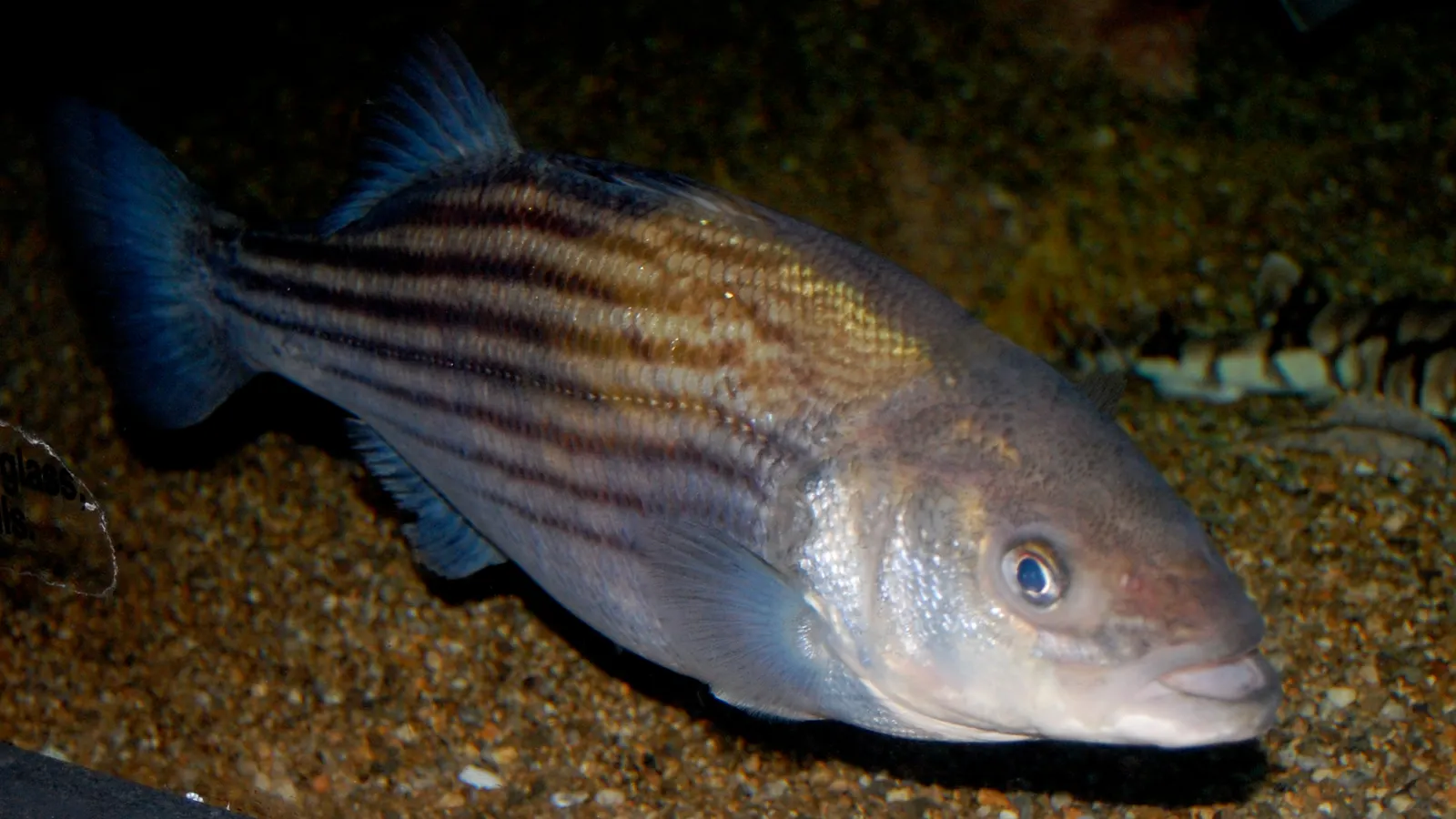

Almost every striper you will catch in Maine grew up somewhere else. Most of the bass in our surf were spawned in Chesapeake Bay, with Hudson River fish mixed into the coastal run, and they swim hundreds of miles north each spring to spend the summer eating in our rivers, estuaries, and beach troughs. The exception is the reason our best striper water has its own rulebook: the Kennebec holds a small spawning population of its own, one that Maine DMR has tracked with a juvenile striper survey every year since 1987.
That migration is the whole game here. You are not fishing for residents. You are intercepting a crowd that arrives in May, settles in for the summer, feeds hard on the way out in the fall, and is gone by November. Time it right and Maine is as good as striper fishing gets north of the Cape.
The season, month by month
| When | What is happening | | --- | --- | | Second week of May | First migrants reach the beaches south of Portland. Ogunquit is usually among the first to see fish. | | Third week of May | Fish spread through the Portland, Yarmouth, and Freeport stretch of Casco Bay. | | End of May | The Kennebec and nearby rivers are holding stripers. Remember: catch and release only in the Kennebec watershed until July 1. | | June | Numbers build coastwide. Fresh, hungry fish and one of the two peaks of the season. | | July and August | Summer residency. Fish settle into rivers, estuaries, flats, and beaches. Kennebec harvest opens July 1. | | September | The fall run builds as bait pushes out of the estuaries. | | Early October | The peak of the fall run, often the best fishing and the biggest fish of the year. | | Late October | The bass push south for the winter. Season is effectively over. |
The practical window is roughly mid-May through mid-October. If you can only fish two stretches, make them June and the last week of September into early October.
Where they run
The Kennebec estuary is the center of gravity. Popham Beach in Phippsburg sits on the south side of the river mouth, and the standard local move is to fish the beach in the one to two hours before high tide. Across the river mouth complex, Reid State Park in Georgetown gives you sand beach and rocky structure near the Sheepscot. The catch: this entire area, everything inside a line from Cape Small to Salter Island to Cape Newagen, including the Kennebec, Sheepscot, and Androscoggin rivers up to head of tide, fishes under the special Kennebec watershed rules covered below. Head of tide on the Kennebec is about 4,200 feet upstream of the Calumet Bridge in Augusta, so “the estuary” is a lot of river.
The southern beaches get fish first and hold them all summer. Saco Bay between Biddeford Pool and Prouts Neck is a striper magnet, with Old Orchard Beach fronting the whole bay. Scarborough Beach State Park sits where the Nonesuch River drains Scarborough Marsh into the bay, and that marsh fills with bait in spring and fall, which makes the river mouth a prime wade spot. Farther south, Ogunquit gives you surf and a river mouth in one stop, with restrooms and a fee town lot off Route 1.
One hard warning on the Saco: the river upstream of the Route 9/Main Street bridge between Saco and Biddeford, up to the Cataract Dam, is closed to fishing. In June 2026 the DMR commissioner put out a notice after Marine Patrol wrote more than 50 summonses in three weeks for fishing that closed water and for fishing within 150 feet of the fishway. They can seize your gear. Fish the bay and the lower river mouth instead.
Casco Bay and the Portland shoreline round it out: rocky shore, coves, and small river mouths that hold summer fish from the third week of May on. If you want the full shore-fishing playbook for any of these, start with our striper surf setup guide.
The rules (2026)
Every fact in this box comes from the official 2026 Maine striped bass regulations, current as of March 25, 2026, and checked July 3, 2026.
| Rule | 2026 Maine regulation | | --- | --- | | Slot limit | 28 to 31 inches total length, inclusive. One straight line, lower jaw to tail tip, tail pinched. Not fork length. | | Bag limit | 1 fish per person per day. Personal use only, no sale, fish stays whole and intact. | | Hooks with bait | Non-offset (inline) circle hook required any time bait is used. | | Gaffing | Prohibited. Hook and line only. | | Statewide season | Open year-round in coastal waters to head of tide, except the Kennebec watershed. | | Kennebec watershed | Closed December 1 through June 30. Catch and release allowed May 1 through June 30 with single-hooked artificial lures only, and no marine bait in your possession. Open season July 1 through November 30. | | Federal waters | Closed. No striper fishing beyond 3 miles from shore. | | Registration | Annual Maine Saltwater Recreational Fishing Registry required: $1 through DMR, $2 at an IF&W license agent. |
Three details anglers get wrong:
- “Bait” is broad. It means any marine or freshwater organism, live or dead, whole or in parts, plus earthworms. The one exception to the circle hook rule is a rubber or latex tube lure at least 8 inches long with a single hook at the end of the tube where bait may be attached.
- Trebles and bait never mix. No bait of any kind on a treble hook, and artificial lures are capped at two treble hooks. A striper that eats bait on an unapproved hook goes back immediately, no photos on the sand first.
- Popham is inside the Kennebec zone. The special-regs line runs from Cape Small to Salter Island to Cape Newagen, which puts Popham Beach and Reid State Park under the Kennebec rules, not the statewide ones. In May and June that means single-hook artificials only, everything released.
How to fish them: bait or plugs
The honest answer is conditions decide, not preference.
Fish bait when the water is rough, discolored, or you are covering a tide. The standard Maine setup is a fresh mackerel chunk on a fish-finder rig: sliding sinker clip with a pyramid or bank sinker, 40 to 50 pound mono leader, and a 6/0 to 8/0 inline circle hook, which is the only legal way to soak that chunk here. The circle hook changes your hookset. Do not swing when the rod knocks. Let the fish turn and load the rod, then wind tight. Done right, the hook finds the corner of the jaw, which matters because the slot is narrow and most of the stripers you land in Maine are going back in the water.
Throw plugs when you can see what the water is doing. At first light at a river mouth, a big pencil popper whipped across the current imitates a fleeing mackerel and draws the most violent strikes of the season. Mid-tide through channels and along drop-offs, a 5 to 6 inch paddletail swim shad fished sink-and-swim is the closest thing to a can’t-miss retrieve. In calm, clear estuary water, a 9 inch soft stickbait rigged weightless on a single swimbait hook matches sand eels and small herring, and that single-hook rigging is also what keeps you legal in the Kennebec zone during the May and June catch-and-release window. When an onshore wind stacks up and nothing else reaches the fish, a 1 to 2 ounce chrome metal cuts through it, and the same lure will catch you fresh mackerel for the bait rig.
One rod covers all of it if you build it right.
Where to go from here
Pick a June or September tide window, register with the state for a dollar, and go stand at a river mouth an hour before high. Start with Popham Beach once the July 1 harvest opener hits, or the Saco Bay and Scarborough beaches any time after mid-May. When you are ready to build the rod and reel out properly, the full breakdown lives in the striper surf fishing setup guide.
Common questions
When do stripers arrive in Maine?
The first migrants usually reach the beaches south of Portland, places like Ogunquit, around the second week of May. The Portland, Yarmouth, and Freeport stretch sees fish by the third week of May, and the Kennebec and nearby rivers hold stripers by the end of the month. Numbers are solid coastwide from early June through July.
Do I need a license to fish for stripers in Maine?
There is no regular saltwater license, but you must sign up with the Maine Saltwater Recreational Fishing Registry each year. It costs $1 through the DMR system or its Augusta office, or $2 at an IF&W license agent. Kids under 16, holders of a current Maine freshwater license (lifetime licenses excluded), and passengers on licensed charter boats are among those exempt.
What size striped bass can you keep in Maine?
One fish per person per day, and it must measure between 28 and 31 inches total length, inclusive. Total length is a straight line from the lower jaw to the tip of the tail with the tail pinched together, not fork length. The fish has to stay whole and intact, and selling your catch is illegal.
Are circle hooks required for striper fishing in Maine?
Yes, whenever bait is on the line. Maine law requires a non-offset (inline) circle hook any time you fish bait for striped bass, and bait includes worms and any part of a fish, dead or alive. The one exception is a rubber tube lure at least 8 inches long with a single hook at the end. A striper hooked on any other setup with bait must go back immediately.
Can you fish for stripers in the Kennebec in June?
Only catch and release. From May 1 through June 30 the Kennebec watershed, which includes Popham Beach and Reid State Park, is catch-and-release only with single-hooked artificial lures, and carrying marine bait there is illegal. Harvest opens July 1 and runs through November 30.