
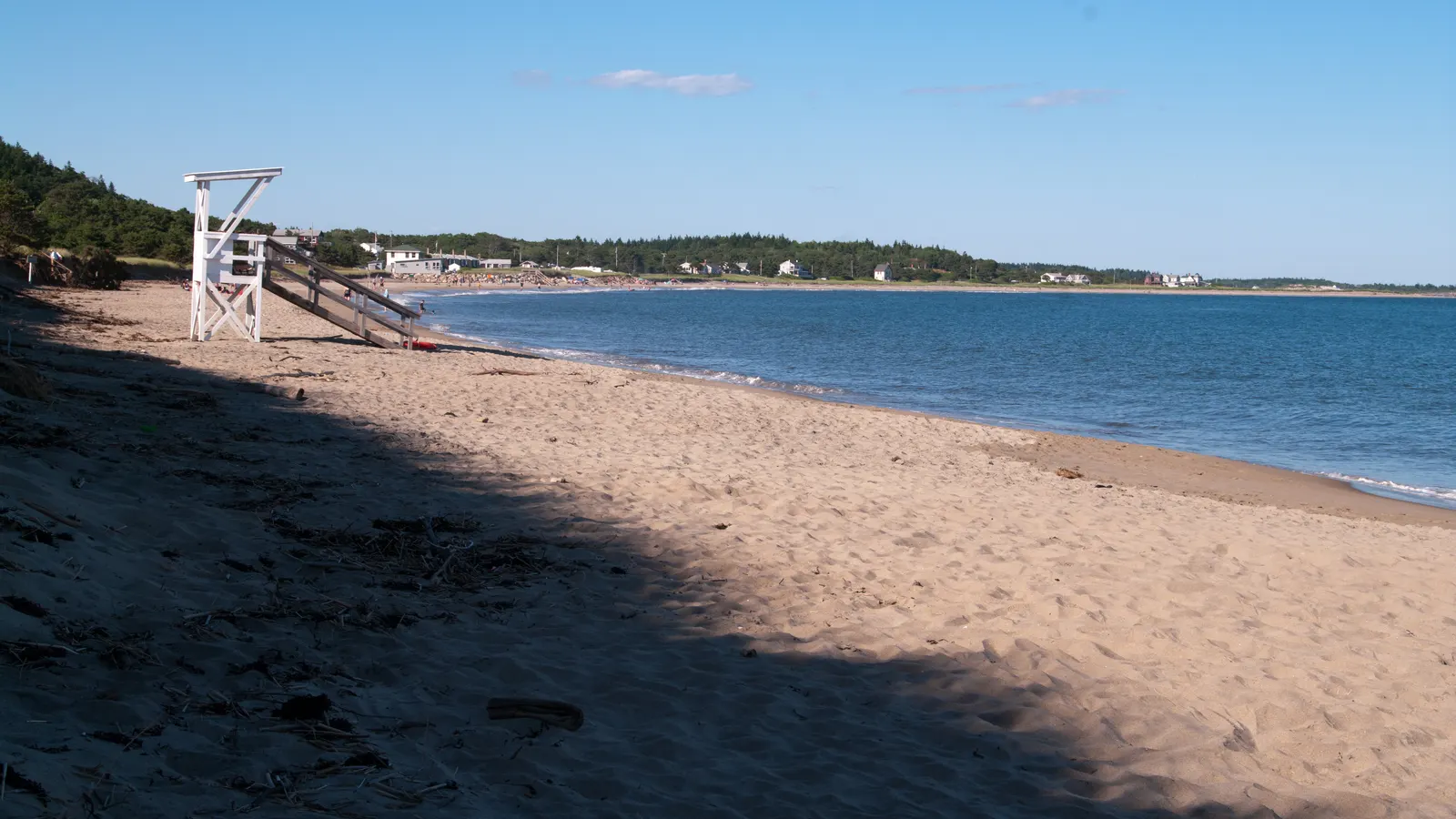

Route 209 runs south out of Bath, winds down the Phippsburg peninsula for 14 miles, and ends in sand. Popham Beach sits on a shifting spit pinched between two river mouths: the Morse River empties across the west end of the beach, and the Kennebec meets the sea past Atkins Bay on the east. Maine DMR calls this one of the most productive surf fishing sites in the state, and the reason is that geography. Two rivers flushing bait across open sand, twice a day, every day.
What runs here, and when
| Species | When | The short version | |---|---|---| | Striped bass | Late May into October | The whole reason this beach has a reputation. Catch and release only May 1 to June 30; keep-one season July 1 to November 30. | | Bluefish | Some summers | A some-years fish, not a promise. When they arrive they will chew through mono leaders and cut soft plastics in half. | | Atlantic mackerel | Summer schools | Fun on a light rod and the best striper bait you can catch on site. Your better shot is the deeper water off Fort Popham, not the open sand. |
The striper timeline, in more detail: the first migrants reach southern Maine around the second week of May, and the Kennebec and the rivers around it usually hold fish by the end of May. Numbers are established coastwide by early June. Fish stay through the summer, then the fall run builds to a peak around early October, which is often the best fishing and the biggest bass of the year, before everything pushes south for the winter.
Access: the park, the fort, and the ramp
Popham Beach State Park is the main entry, at the end of Route 209 with a real parking lot, restrooms, and changing rooms. There is a day-use entrance fee. The park is open all year, 9:00 a.m. to sunset unless otherwise posted, and that 9:00 a.m. gate matters to an angler: a dawn tide from the state park lot is not on the table.
Fort Popham, a few miles beyond the park where Route 209 finally quits, puts you on the Kennebec side with shoreline and dock fishing right at the river mouth. When the schedule or the gate rules out the beach, this is the fallback.
Morse Cove Public Launch in Phippsburg is the boat option for the lower Kennebec, and DMR describes it as one of the busiest ramps in the state. On a July weekend, believe it.
The rules are different on this beach
Striped bass rules at Popham, 2026 (checked July 3, 2026). Popham Beach and the state park waters sit inside DMR’s Kennebec watershed special-regulation zone, the area inside a line from Cape Small at the tip of Phippsburg out to Salter Island and over to Cape Newagen on Southport. That zone runs on its own calendar:
- December 1 to April 30: closed to striped bass fishing, full stop.
- May 1 to June 30: catch and release only. Single-hooked artificial lures only (that one hook may be a treble). Marine bait, dead or alive, is prohibited.
- July 1 to November 30: open season. One fish per person per day, and only between 28 and 31 inches total length, measured jaw to pinched tail.
- Whenever bait is on the hook, Maine requires a non-offset circle hook. No gaffing, and a kept fish must stay whole and intact.
Statewide context and the fine print live in our Maine seasons and regulations guide. You also need the $1 saltwater registry before you cast; the license guide covers who is exempt.
Plenty of people drive down in early June expecting to soak a chunk of mackerel, because that is legal on most of the Maine coast. Here it is a summons. The July 1 opener means more at Popham than almost anywhere else in the state.
How to fish it
Start with the standard local advice: be fishing one to two hours before high tide. But the real pattern at Popham is current, not clock. The two river mouths act like funnels. Dropping water pulls bait out of the Morse River and off Atkins Bay, rising water pushes it back across the bars, and the stripers hold on the seams where moving water shears past slack. Find the line where current meets calm, usually visible as a change in surface texture or a row of standing chop, and work your casts along it rather than straight out to sea.
And remember none of it is fixed. This is a famously restless piece of sand: the Morse River channel wanders, bars move after every big blow, and the beach you fished last October may be shaped differently this July. At low water a bar opens toward Fox Island; it covers on the flood and the park warns people off it for good reason, so if you walk out to fish it, watch the water behind you. Walking the beach at dead low once before you fish it is worth more than any report.
May and June: release water, artificials only
The fish beat the harvest season here by a month or more, and the law shapes the tactics. Single-hooked artificials only means a paddletail on a jighead is the natural tool: swim it along the Morse River seam on the outgoing tide, slow enough to tick the sand. A single-hook needlefish or a small metal-lip works the same water after dark. Leave the sandworms and the chunk bait in the truck; until July 1 they are illegal on this beach, not just frowned on.
July through September: the harvest window
July 1 the zone opens and bait becomes legal, with the circle-hook rule attached. A fish-finder rig with a fresh chunk of mackerel, cast into the Kennebec-side current and left to sit, is the classic Popham program, and you can often catch the mackerel the same day off Fort Popham. Plug fishermen do their work on the moving tides: pencil poppers when there is chop, soft plastics when it lays down flat and calm. Midsummer brings the crowds, so fish the edges of the day and let the beach towels have 11 to 4.
Late September and October: the fall run
This is the payoff. The migration peaks around early October, the biggest fish of the year come through with it, the tourists are gone, and the parking is easy. Bigger plugs earn their keep now, because the bass are feeding to travel. The keep-season technically runs to November 30, but the run is mostly past by then; come November you are casting at stragglers.
What we’d rig for this beach
Popham asks more of tackle than a tidal creek does. There is real surf, real river current, and on some tides a long cast to reach the seam. This is exactly the water the 10-foot setup was built for.
Keep reading
- Striped bass in Maine: the full species hub, migration and all.
- Surf fishing in Maine: technique from the ground up, beyond this one beach.
- The striper surf setup: every piece of the rig above, with the reasoning.
Common questions
Do I need a fishing license to surf fish Popham Beach?
Not a conventional license, but you do need to be on the Maine Saltwater Recreational Fishing Registry. It costs $1 through Maine DMR (or in person at the Augusta office) and $2 through an appointed license agent. Kids under 16 and holders of a current Maine freshwater license (lifetime licenses excluded) are among the exempt groups.
When can I keep a striped bass at Popham Beach?
July 1 through November 30, and only a fish between 28 and 31 inches total length, one per person per day. From May 1 through June 30 this water is catch and release only, with single-hooked artificial lures and no marine bait. From December 1 through April 30, striped bass fishing here is closed entirely.
What is the best tide to fish Popham Beach?
Start one to two hours before high tide; that is the standard advice for this beach. Moving water matters more than the exact stage, so plan around the current seams off the Morse River mouth and the Kennebec side. Dead slack is the only stage that consistently fishes poorly.
Are there bluefish at Popham Beach?
Some summers, yes. Bluefish are a boom-or-bust visitor to Maine, so treat them as a bonus, not a plan. If fish start cutting through your leader like it is not there, that is your answer.
How much does Popham Beach State Park cost to get into?
There is a day-use entrance fee at the gate; check the Maine Bureau of Parks and Lands page for current rates before you go. The park is open all year, 9:00 a.m. to sunset unless otherwise posted.